

How do AI-generated fake images fool people?
JournalismPakistan.com | Published: 1 August 2026 | JP Special Report
Join our WhatsApp channel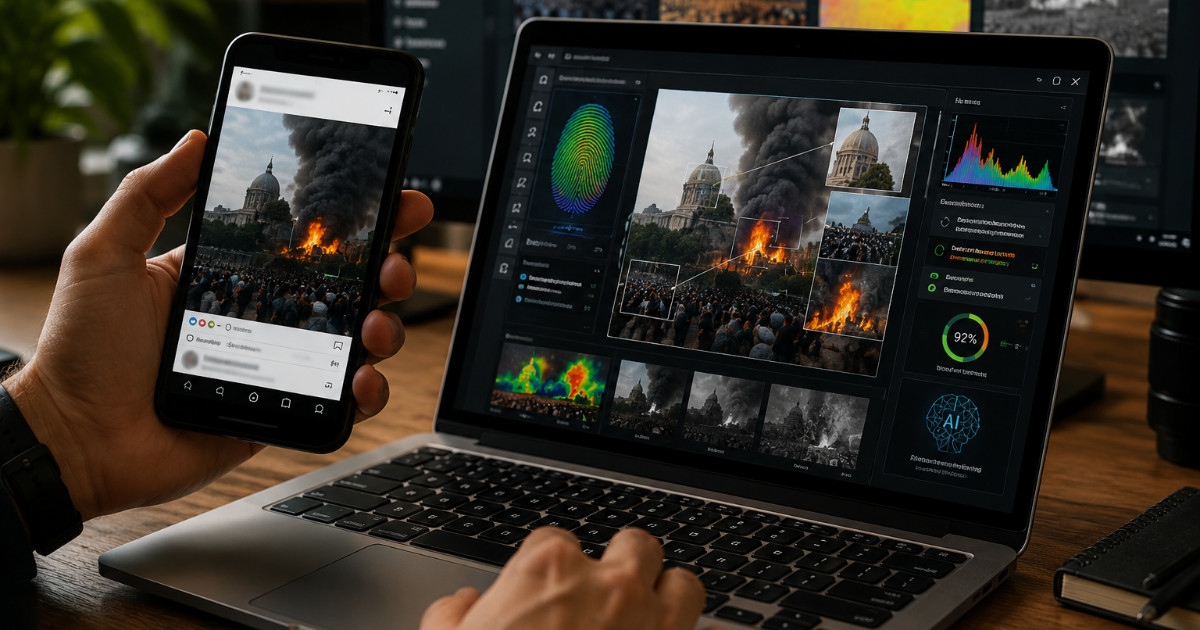
Generative AI now produces realistic images of events or people that never happened, and such visuals are widely shared on social platforms. Although many are artistic, some are used to spread misinformation, impersonate people or aid scams.Summary
ISLAMABAD — Artificial intelligence has made it easier than ever to create realistic-looking images of events, people, and places that never existed. As AI image-generation tools become more powerful and widely available, fabricated visuals are increasingly appearing on social media, messaging apps, and even alongside false news reports.
The growing sophistication of these images has made them harder for the public to identify. While many AI-generated pictures are created for harmless entertainment or artistic purposes, others have been used to spread misinformation, manipulate public opinion, impersonate individuals, or support scams. Understanding how these images are created and shared has become an important part of digital literacy.
What are AI-generated fake images?
AI-generated fake images are pictures created or heavily altered using artificial intelligence rather than captured by a camera. Most are produced using generative AI models that convert written text prompts into highly detailed images.
Popular AI image generators can create convincing scenes in seconds. A user might ask an AI system to produce a realistic image of a political rally, a natural disaster, or a celebrity in a specific situation. Although the resulting image may appear authentic, the depicted event may never have occurred.
Not every AI-generated image is deceptive. Many are clearly labeled as artwork, illustrations, or creative experiments. Problems arise when fabricated images are presented as genuine photographs.
How does AI create realistic images?
Modern AI image generators are trained on vast collections of publicly available images and associated text. During training, the systems learn patterns such as lighting, facial features, textures, colors, and object relationships.
When someone enters a prompt, the AI predicts what the requested scene should look like based on those learned patterns. Advanced systems can produce highly detailed faces, landscapes, buildings, and objects that closely resemble real photographs.
Many tools also allow users to edit existing images by adding, removing, or changing elements, making it even easier to create convincing fabrications.
Why do people believe fake AI images?
Human psychology plays a significant role in why fake images spread.
People often assume that photographs represent reality. Visual content is generally processed more quickly than written information, making images emotionally persuasive even before viewers stop to question their authenticity.
Several factors increase the likelihood that people will believe AI-generated images:
- Images often confirm existing beliefs or biases.
- Social media encourages rapid sharing before verification.
- Fake images are frequently accompanied by convincing captions.
- High-quality AI visuals can closely imitate professional photography.
- Emotional content tends to attract more engagement than factual reporting.
Researchers studying misinformation have consistently found that emotionally charged visuals can influence public perceptions even after they have been debunked.
Where are AI-generated fake images commonly used?
Fabricated AI images have appeared across many areas of public life.
During elections, false images have depicted political candidates at fictional events or falsely suggested violence or misconduct. Election authorities in multiple countries have issued warnings after AI-generated visuals circulated online.
During natural disasters, fabricated photographs have falsely shown dramatic flooding, collapsed landmarks, or rescue operations that never happened. Such images can distract emergency responders and confuse the public.
Scammers have also used AI-generated profile pictures to create fake social media accounts, fraudulent investment schemes, and romance scams.
Entertainment and satire accounts sometimes publish AI-generated images for humorous purposes, but these can spread beyond their original context and be mistaken for genuine photographs.
Can AI-generated images be detected?
Detection has become increasingly difficult as image-generation technology improves.
Obvious flaws that once exposed AI-generated images, such as distorted hands, inconsistent shadows, or unusual facial features, have become less common in newer systems.
Instead, investigators increasingly rely on a combination of techniques, including:
- Reverse image searches.
- Checking image metadata when available.
- Examining inconsistencies in lighting, reflections, or backgrounds.
- Comparing the image with verified reporting from trusted news organizations.
- Using specialized forensic and AI-detection tools.
No single detection method is completely reliable. Many experts recommend combining technical analysis with traditional fact-checking techniques.
What role do social media platforms play?
Major technology companies have introduced various measures to reduce the spread of deceptive AI-generated content.
Some platforms apply labels to certain AI-generated media or develop systems to identify manipulated content. Others have updated policies covering synthetic media, particularly when it could mislead voters, impersonate individuals, or contribute to fraud.
However, enforcement varies across platforms, and many fabricated images continue to circulate before moderators can review them.
Several AI companies have also begun embedding digital watermarks or metadata into AI-generated content. Standards such as the Coalition for Content Provenance and Authenticity (C2PA) aim to improve transparency by allowing participating systems to record information about how digital content was created or edited. Adoption, however, is not yet universal.
What should journalists know?
News organizations face increasing pressure to verify visual material before publication.
Many newsrooms now require additional verification of images obtained from social media, especially during breaking news. Editors may compare photographs with satellite imagery, eyewitness accounts, official statements, and other independently verified evidence.
Journalists should avoid relying solely on AI-detection software because no current tool can guarantee accurate results. Verification remains a combination of technical analysis and traditional reporting.
When using AI-generated illustrations for explanatory or creative purposes, clear labeling helps distinguish them from documentary photographs.
Are governments regulating AI-generated images?
Governments are increasingly examining how synthetic media should be regulated, particularly in areas involving elections, fraud, identity theft, and non-consensual intimate imagery.
Regulatory approaches differ across jurisdictions. Some countries have introduced disclosure requirements for certain AI-generated political content, while others are considering broader AI legislation covering transparency and accountability.
At the international level, organizations including the European Union have adopted AI-related regulations that address transparency obligations in some contexts. Meanwhile, governments in other regions continue to develop or debate their own legal frameworks.
Because laws are evolving rapidly, journalists and publishers should monitor the latest legal requirements in the jurisdictions where they operate.
What can ordinary users do?
Individuals can reduce their risk of being misled by slowing down before sharing dramatic or emotionally charged images.
Helpful habits include checking whether reputable news organizations have reported the same event, looking for the source of the image, and treating extraordinary claims with appropriate skepticism until independently verified.
Media literacy experts emphasize that critical thinking remains one of the most effective defenses against visual misinformation.
What happens next?
AI image-generation technology is expected to continue improving, making fabricated visuals increasingly realistic.
At the same time, researchers, technology companies, governments, and news organizations are investing in better detection tools, provenance standards, and public education. The challenge is likely to remain an ongoing competition between increasingly sophisticated image-generation systems and increasingly advanced verification methods.
Why this matters
AI-generated fake images are becoming a routine challenge for journalists, fact-checkers, and news consumers. Accurate visual verification is now an essential newsroom skill, particularly during elections, crises, and breaking news. Understanding how synthetic images are created and detected helps reduce the spread of misinformation and supports more trustworthy reporting.
Key takeaways
- AI-generated images can appear highly realistic despite depicting events that never occurred.
- Emotional and convincing visuals often spread faster than verified information.
- No single tool can reliably detect every AI-generated image; multiple verification methods are necessary.
- Journalists should verify images using traditional reporting techniques alongside technical analysis.
- Media literacy and careful verification remain the strongest defenses against visual misinformation.
ATTRIBUTION: Reporting by JournalismPakistan, based on publicly available laws, official documents, court records, regulatory notices, academic research, and reporting from credible news organizations where applicable.
PHOTO: AI-generated; for illustrative purposes only
Key Points
- Generative models create images from text prompts or by remixing training data.
- AI images can match realistic lighting, textures and facial features, making them convincing.
- They spread rapidly on social platforms and messaging apps, often without clear labels.
- Identifying fakes requires verification tools, source checks and careful scrutiny.
- User education and platform policies help limit misuse and reduce harm.
Key Questions & Answers
What are AI-generated fake images?
They are pictures created or heavily altered by generative AI rather than captured by a camera, often made from text prompts or by combining large datasets.
How do such images fool people?
High visual realism, plausible context, emotional content and rapid sharing make them appear authentic, especially when labels or verification are absent.
How can a reader spot a fake image?
Check the source, use reverse image search, look for visual inconsistencies or missing metadata, and consult trusted fact-checkers and verification tools.
What should you do if you find a suspicious image?
Do not share it, verify with reliable sources or tools, report it to the platform if it violates rules, and inform others if it spreads harmful misinformation.
Relevant Topics
Ask AI: Understand this story your way
AI EnabledDig deeper, ask anything — get instant context, background, and clarity.
Disclaimer: This feature is powered by AI and is intended to help readers explore and understand news stories more easily. While we strive for accuracy, AI-generated responses may occasionally be incomplete or reflect limitations in the underlying model. This feature does not represent the editorial views of JournalismPakistan. For our full, verified reporting, please refer to the original article.